

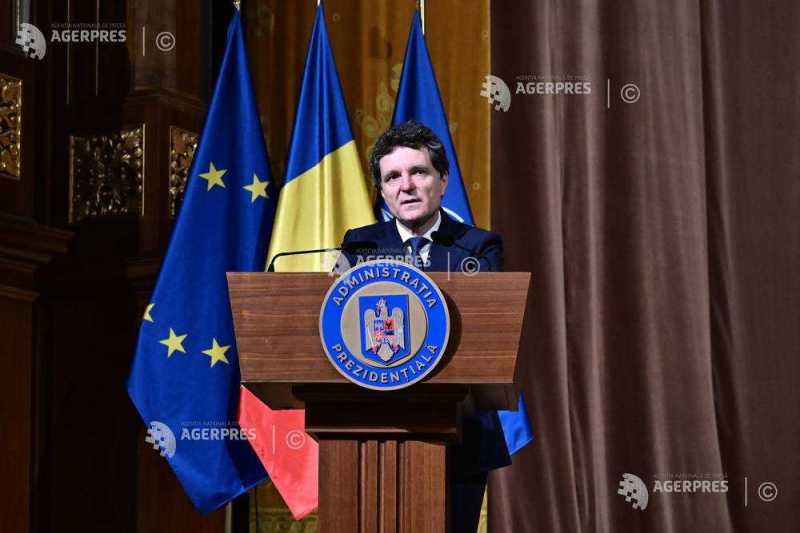
President Nicusor Dan said on Friday, on Romania's National Holocaust Remembrance Day, that turning to memory and history is crucial to understanding how the crimes and atrocities committed on Romanian territory were possible, with the involvement of the Romanian state authorities and the complicity of those who remained indifferent.
'Today, we pay tribute to the memory of the victims of the Holocaust in Romania, Jews and Roma, as well as people from other ethnic groups, Romanian citizens who lost their lives because of totalitarian ideologies and policies. Turning to memory and history is crucial to understanding how the crimes and atrocities committed on our country's territory were possible, with the involvement of the Romanian state authorities and the complicity of those who remained indifferent, lacking the courage to rise up against the violence and injustice inflicted on their fellow human beings. Fortunately, there are witnesses, Holocaust survivors, there are testimonies that bring us closer to the historical truth, helping us reflect on it honestly. It is important to recognise that, alongside the Holocaust across Europe, which led to the persecution and extermination of approximately six million Jews and Roma, there was, sadly, also the Holocaust in Romania, with its own history, victims, survivors and those responsible,' the head of state underscored in his message to the annual Holocaust victims' commemoration ceremony, delivered by Presidential Adviser Cristian Rosu.
In his message, the Romanian president stressed that 'this day brings us to mind that acknowledging and understanding this painful chapter in our own history are essential to observing human dignity and ensuring that such tragedies never happen again.'
'Every year, on 9 October, Romania commemorates the victims of the Holocaust, keeping alive the memory of Jews and Roma who, between 1938 and 1944, were subjected to persecution, pogroms, deportations to Transnistria and executions by the Romanian authorities in territories under Romanian administration. (...) At the present time, as we face major and rapid changes that generate uncertainty and fears about the future, we all have a great responsibility to act with wisdom and clear-sightedness to prevent hatred, discrimination of any kind and antisemitism from taking root again. Today, Holocaust remembrance is part of our national and European identity, through the most tragic experience of the 20th century, we have all learned that peace, freedom and democracy are not guaranteed for ever, but must be defended by every generation. The memory of the past obliges us all to turn the lessons of history into responsibility, and responsibility into solidarity and hope,' Nicusor Dan conveyed.
***
On 9 October 1941, the deportation of Jews from Bessarabia, Southern Bukovina and Northern Bukovina to Transnistria began. In October 1941 alone, more than 35,000 Jews, mostly children, elderly people and women, from Dorohoi, Suceava, Campulung Moldovenesc, Vatra Dornei, Radauti, Gura Humorului and other nearby localities were escorted to Transnistria.
According to the 'Elie Wiesel' Institute, the overall scale of the atrocities shows that more than 300,000 Jews of Romanian or Ukrainian origin died from fire, cold, hunger or disease, while 11,000 Roma were exterminated in Transnistria by the Romanian authorities as a result of the racial policies of the Antonescu regime.
In Romania, Government Decision No. 672 of 5 May 2004 established 9 October as the official National Holocaust Remembrance Day. Under this decision, the Romanian authorities organise events each year on 9 October dedicated to the memory of the Holocaust, including conferences, seminars, book launches, performances and school competitions. AGERPRES (RO - writing by: Daniel Popescu; EN - writing by: Rodica State)
- Category: English
- Date: 2026-10-09 13:22:46
- Foto: MIHAI POZIUMSCHI / AGERPRES PHOTO