

More than 60 varieties of gourds and calabashes, shaped like acorns, hourglasses and pears, with 'warts' or 'fingers,' are part of the collection of the Buzau Plant Genetic Resources Bank (BRGV), symbols of autumn closely associated with the rural world of times gone by.

Photo: (c) FLORIN ZAFIU / AGERPRES FOTO
Gourds and calabashes, climbing plants belonging to the cucurbit family, are mainly used for decorative purposes, with unusual shapes and a rind that becomes hard over time, allowing them to be preserved for long periods. The best-known shape of calabashes is that of an hourglass or the number eight (8). Before the advent of plastic and mass-produced glass, calabashes were commonplace in rural households, where they were used instead of bottles and funnels and commonly used to store seeds or salt. They could also be turned into musical instruments or decorative lamps.

Photo: (c) FLORIN ZAFIU / AGERPRES FOTO
'We have more than 60 such stabilised varieties in the Bank, each with distinctive characteristics. The species commonly known as the calabash was valued for its decorative beauty. Calabashes were once used in households and are still used in some parts of the country to store seeds. When they reach maturity, they dry out, the stem at the top of the fruit is cut off, the seeds are removed and vegetable seeds can be stored inside very effectively throughout the year. So here we are talking about natural packaging, a natural storage container that preserves seeds very well. On the other hand, calabashes were also used in households to draw liquids from barrels, especially large vessels. Those with longer stems were used instead of hoses: a hole was made in the bottom of the fruit and they were used to draw out liquids. They were also made into musical instruments, although they are generally used for decorative purposes,' BRGV Buzau Director Costel Vinatoru told AGERPRES.

Photo: (c) FLORIN ZAFIU / AGERPRES FOTO
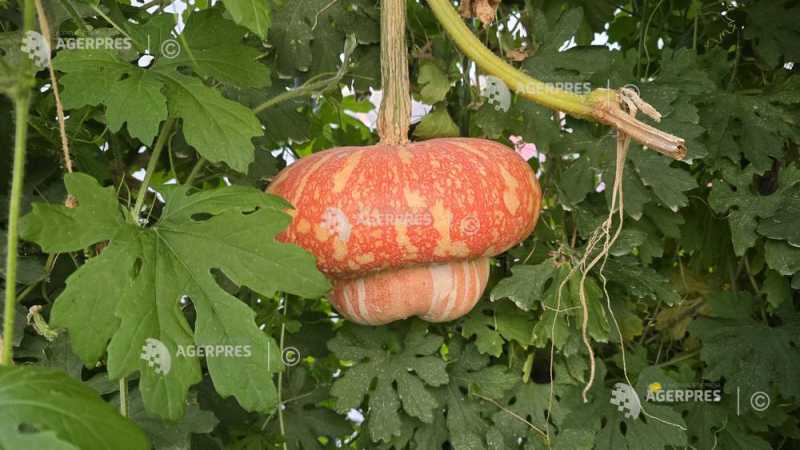
In October, the BRGV greenhouses are naturally decorated with dozens of gourds from distinct varieties. In interior design and decorative arrangements, gourds are the stars of autumn decor thanks to their spectacular and bizarre shapes. They can resemble acorns or pears, have a strange turban-like shape, be spherical or covered with bumps or 'warts,' small protrusions that give them an otherworldly appearance.

Photo: (c) FLORIN ZAFIU / AGERPRES FOTO
'In general, the shape of gourds varies widely, starting with the pear shape. Some can have ridges, others stripes, some weigh between one and two kilograms, and they can have growths and many irregular 'warts' on the outside. They come in different colours, from white and waxy white to yellow, combinations of green, yellow and white, and orange. They were widely cultivated in the past and were found in every household, valued primarily for their beauty as decorative fruits. In the countryside, windows were adorned with flowers, quinces, 'Prince's Apple' and gourds. They were especially popular with children, who used them in their games and loved them because they came in different shapes, sizes and colours. These species are resilient and were among the first to be used as rootstocks, particularly for grafting melons,' Costel Vinatoru explains.

Photo: (c) FLORIN ZAFIU / AGERPRES FOTO
Their spectacular shapes give rise to distinctive decorative arrangements. Gourds can be placed on windowsills, used as centrepieces on tables, while smaller ones can be incorporated into wreaths or turned into lanterns, lamps or birdhouses. There are also edible species that retain the unusual shapes for which calabashes and gourds are known.
Maintaining the authenticity of the lines is difficult, researchers at the Bank say, because the varieties can easily cross-pollinate, producing unstable or new offspring.

Photo: (c) FLORIN ZAFIU / AGERPRES FOTO
'We are talking about a wide range of species, most of them from the pumpkin family, the pumpkins and squashes of our ancestors, belonging to the cucurbit family. We also have edible species, such as pattypan squash, also known as 'finger squash.' Before today's courgette, pattypan squash was used, a relative of the gourds we preserve. Pattypan squash is very tasty, with much denser flesh and a refined flavour. In old literature, we do not find courgettes, but we find pattypan squash, pumpkin, pie pumpkin and baking pumpkin. This interplay of colour and size is almost unpredictable. You plant a seed from one fruit and the following year you may be surprised to find new varieties, which is why genetic stabilisation is very difficult. Here we use these greenhouses, which have insect-proof netting and help protect them from foreign pollen,' says Costel Vinatoru.

Photo: (c) FLORIN ZAFIU / AGERPRES FOTO
Beyond the scientific work involved in exploring, cataloguing, collecting, researching and preserving plant genetic resources, the varieties in the BRGV collections are strongly rooted in local traditions and the history of Romanian agriculture. Gourds, calabashes and pumpkins are no exception, representing both a symbol of autumn and a close link with the rural world of times gone by.

Photo: (c) FLORIN ZAFIU / AGERPRES FOTO
'These are part of our tradition. Every household had this wealth, and each family identified in some way with the species of gourds it cultivated and preserved. Their beauty was discovered in a particular way. They were not visible; in the countryside there were no separate crops, as they were grown among maize, beans or on trellises. Only after harvesting were they revealed and their beauty appreciated. They are part of Romanian peasant culture. They were present in various arrangements at certain ceremonies in the home and provided a splash of colour and beauty to each household. A house was also judged by this natural decoration, showing the hard work and the family's appreciation of beauty and of working the land. They are a symbol of the beauty of autumn, like natural works of art. We are talking about an important page in the history of our people and we must save these seeds that were cultivated by our ancestors. That is our main mission: to save this treasure. We are not only saving the seeds, but also their story,' Costel Vinatoru stressed.

Photo: (c) FLORIN ZAFIU / AGERPRES FOTO
The BRGV Buzau has more than 20,000 plant varieties in its biobanked collection, mainly vegetables and flowers, as well as aromatic and medicinal plants. AGERPRES (RO - writing by: Florin Zafiu; EN - writing by: Adina Panaitescu)
Buzau Plant Genetic Resources Bank boasts over 60 varieties of gourds with spectacular shapes
Conţinutul website-ului www.agerpres.ro este destinat exclusiv informării publice. Toate informaţiile publicate pe acest site de către AGERPRES sunt protejate de dispoziţiile legale incidente. Sunt interzise copierea, reproducerea, recompilarea, modificarea, precum şi orice modalitate de exploatare a conţinutului acestui website. Informaţiile transmise pe www.agerpres.ro pot fi preluate, în conformitate cu legislaţia aplicabilă, în limita a 500 de semne. Detalii în secţiunea Condiţii de utilizare. Dacă sunteţi interesaţi de preluarea ştirilor AGERPRES, vă rugăm să contactaţi Direcţia Marketing - marketing@agerpres.ro.
Alte știri din categorie

Monthly average income stands at 10,204 lei per household in Q2 2026; expenditure totals 8,650 lei
Monthly average income per household stood at 10,204 lei in Q2 of 2026, up 8% from Q1 of 2026 in nominal terms, according to the National Institute of Statistics (INS) data published on Wednesday. Compared with Q2 of 2025, total monthly average household income increased by 7.4%, while income per person rose by 10.4% to 4,222 lei. Monthly averag

Organists Maria-Luisa Antal and Eduard Antal - extraordinary recital at Romanian Athenaeum on 11 October
Organists Maria-Luisa Antal and Eduard Antal will give an extraordinary recital at the Romanian Athenaeum on 11 October as part of the eighth edition of the 'Organs of Romania' National Tour. According to a press release the organisers sent to AGERPRES on Wednesday, the morning recital is the final concert of the autumn leg, following performances in T

Nicusor Dan phones António Costa: We actively support EU membership of Moldova and Ukraine
President Nicusor Dan spoke by phone on Tuesday with European Council President Antonio Costa about key-topics on the agenda of the Council meeting scheduled for October 15-16. 'The Council's agenda is very packed because we have many important files to discuss, ranging from boosting economic competitiveness and energy prices to the Union's future

Inaugural edition of Romania-US Exchange Program; Toiu: We mark firm new step in bilateral relationship
The Ministry of Foreign Affairs is organizing the inaugural edition of the Romania-United States Exchange Program until October 11; as part of this initiative, a delegation comprising aides to US Congress members and representatives of the American think-tank community is visiting Romania. According to a release by the Ministry of Foreign Affairs, the visiting

Nicusor Dan, discussion in 'Friends of Competitiveness' Group: Member states agree on measures to mitigate energy prices
The member states of the 'Friends of Competitiveness' group agree on the need for urgent measures to mitigate energy prices, for instance, through greater budgetary flexibility in implementing compensatory support measures, stated Nicusor Dan on Tuesday, adding that Romania supports realistic solutions that allow domestic industry to develop and undergo the climate t

President Nicusor Dan: As historical realities are being called into question, we need to turn to specialists
President Nicusor Dan stressed on Tuesday the importance of knowing history at a time when historical values and realities have increasingly come under scrutiny. Speaking at the event 'The Holocaust: A Testimony for Young People,' Nicusor Dan drew attention to the risk of blaming a minority for the weaknesses and shortcomings of society.

Cristela Georgescu accuses Nicusor Dan of political pressure against her husband
After spending several hours at the DIICOT headquarters, Calin Georgescu's wife, Cristela, complained on Tuesday about the 'brutal' and 'inhumane' manner in which police officers stormed into her family's villa in Mogosoaia, claiming that the case involving her husband's arrest amounts to 'political persecution.' She also ac

Patriarch Daniel: Church has responsibility to support and strengthen Christian family
Patriarch Daniel of the Romanian Orthodox Church (BOR) emphasized on Tuesday that the Church has a responsibility to support and strengthen the Christian family. 'In this society, marked by a host of changes and challenges such as migration and professional mobility, rapid secularisation and a lack of knowledge of Christian values, the excessive influence